From newspaper boy to journalist

LORESTAN, Noorabad – Sometimes a newspaper is more than a few pages of paper and a collection of news stories. It is part of the memories of an entire generation — a generation that waited for newspapers to arrive, patiently anticipated the publication of a report, and discovered the wider world through printed pages.
For me, newspapers and journalism have been an integral part of both my childhood and my professional life. It was a journey that began at the Kayhan newspaper distribution office in Noorabad, Delfan County, and eventually led me to journalism, television reporting, and a long-standing collaboration with Mehr News Agency.
The Kayhan newspaper office in Delfan County, located on Imam Khomeini Street, was established in 1987 by my elder brother, Ali Moazami Goudarzi, following several years of journalistic work. From my early childhood, I was therefore familiar with the world of newspapers and the press.
It was the early 1990s. Noorabad was still a small town, and its urban population was nowhere near what it is today. Yet even in that small town, there were people who valued reading and eagerly awaited the arrival of newspapers.
In those days, around 70 copies of Kayhan, along with magazines, weekly and monthly publications, and other affiliated periodicals, were delivered to us.
Our work in the press, however, was not limited to Kayhan. We subsequently became distributors and representatives of several widely circulated national newspapers, including Iran, Resalat, Jomhouri-e Eslami, Ettela'at and Hamshahri. We also distributed publications such as Sobh-e Emrooz and Hayat-e No, along with other national newspapers and periodicals.
In fact, that small press office in Noorabad brought together newspapers with different viewpoints and political orientations, each with its own readership.
Today, seeing such a variety of publications in a small town may not seem particularly unusual. But things were different back then. There was no internet, no social media and no smartphones. A newspaper was an event in itself.
Readers waited for the papers to arrive, and each newspaper held particular significance for a specific group of people.
Newspapers that arrived the following afternoon
In those years, newspapers were handed over to buses bound for Delfan at Tehran’s South Terminal. Given the condition of the roads leading to the county, particularly the unpaved Noorabad-Nahavand route, they would reach us the following afternoon.
I clearly remember the price of Kayhan: just two tomans!
I distributed the newspapers across town in two or three rounds. If I had classes in the morning, I would start delivering them after noon. If my classes were in the afternoon, I would distribute the newspapers and magazines among government offices and some schools in the morning.
It was hard work, but I genuinely enjoyed it.
Many days, all the newspapers would sell out. Sometimes, a customer would give me five tomans instead of the two-toman price.
For a child of that age, having some money of his own and putting what he had earned through his work into a piggy bank was a wonderful feeling.
Of course, this did not mean that my family was struggling financially. Thankfully, my father had a business, earned an honest living, and provided us with a good life. What mattered to me was the experience of working, taking responsibility, and interacting with people.
Tehran Times: ten copies for a small town
Among all those newspapers and publications, Tehran Times held a special appeal for me. In those days, it reached Delfan through Kayhan's distribution network.
Its distinctive appearance and English-language content fascinated a child like me. I remember seeing copies with their striking red-and-white design. I even imagined that perhaps the newspaper was being sent to us from abroad.
But something even more interesting was that all ten copies of Tehran Times delivered to the county had regular buyers.
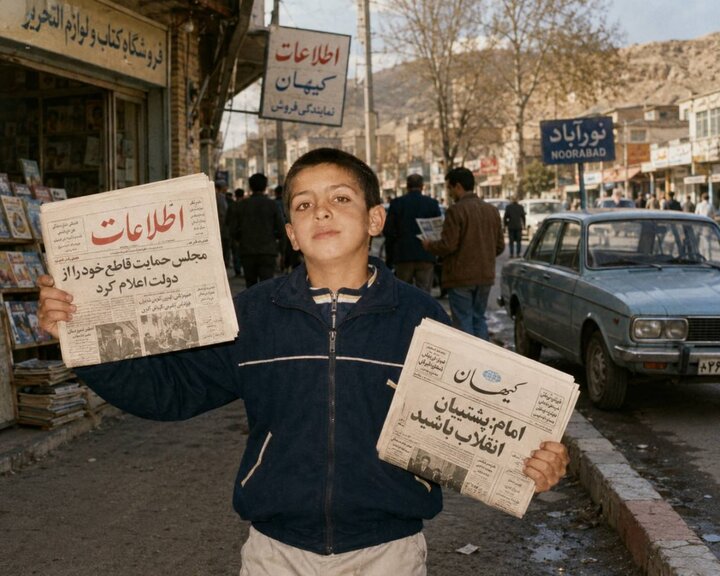
As far as I can remember, most of its readers were English teachers, including Dr. Yousef Reza Jahaniyan, the current head of Delfan’s Health Network, as well as Messrs. Rahimi, Ahmadi, Sabzian, Piri, Kazemi and Hosseini. There were also readers at Imam Khomeini Boys’ High School and Sadr Girls’ High School.
For a child who did not yet have a command of English, it was fascinating to see that an English-language newspaper had a regular readership in Noorabad.
Looking back today, I realize that those ten copies of Tehran Times were more than just ten newspapers. They were ten windows opening onto a world far larger than Delfan.
Beside the kerosene heater: where a child learned from elders
When I was nine or ten years old, I delivered newspapers to some customers who were avid readers and thoughtful people who enjoyed conversation.
Winters in Delfan were cold and snowy. Sometimes, after delivering a newspaper, I would stand beside the kerosene heater in a shop or workplace to warm myself. But I did not stay there merely to escape the cold. I stayed to listen to what people were saying.
I was a child, sitting alongside adults and learning from their conversations and experiences.
Today, I feel that at least part of my interest in dialogue, news and storytelling may have taken shape during those very years.
My first published piece
My first written contribution was published in 1994 in Kayhan Bacheha, a weekly children's newspaper that came out every Tuesday. My text appeared alongside my photograph, and for a child, it was an extraordinary and delightful experience.
Later, alongside my brother, at the office we operated under the name Goudarzi Press, we published special editions, wrote articles, and reported on the deprivation and difficulties facing local people.
Whenever a report led to a result and we saw the public response, we felt that we had done something worthwhile.
I learned the profession of journalism from my brother, Ali Moazami Goudarzi, and spent years learning and honing my skills under his guidance.
Alongside my work in print journalism, I also worked as a cameraman for the Central News Unit. In May 2003, my first television report was broadcast by Lorestan’s Aflak TV channel. From that point on, my professional career as a journalist and reporter continued.
In 2006, coinciding with the establishment of Mehr News Agency’s bureau in Lorestan Province, I began a sustained collaboration with the agency. That cooperation, alongside my other media activities, continues to this day.
When Tehran Times became part of my professional journey
In 2007, I prepared an extensive report on the Agricultural Jihad Organization in Delfan County, which was published in Tehran Times and occupied roughly half a page of the newspaper.
For me, that was a particularly meaningful moment.
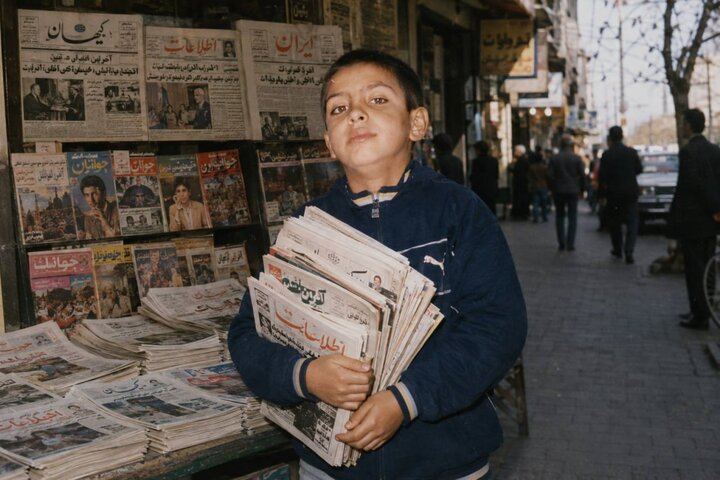
The child who had spent years distributing Tehran Times in the streets of Noorabad was now seeing his own report published in the same newspaper. It felt as though the newspaper that had once passed from the hands of a young newspaper delivery boy in Delfan to local English teachers was, years later, carrying that same boy’s voice to its readers.
A childhood memory comes alive again in Khorramabad
Recently, Ms. Hosseini, the head of Mehr News Agency’s Lorestan bureau, invited me to attend a gathering in Khorramabad with the agency’s chief executive officer, along with a number of its managers and staff members, and journalists from across the province.
I gladly accepted the invitation and travelled to Khorramabad.
The meeting was a valuable opportunity to meet and talk with some of the country’s experienced media professionals, and I greatly benefited from attending.
During the discussions, I learned that the editor-in-chief of Tehran Times was also among the participants.
At that very moment, memories of my childhood came flooding back.
I immediately called Engineer Ali Khademi, who headed the Agricultural Jihad Department in Delfan in 2007, and asked whether he still had a copy of the Tehran Times issue that had published my report on agricultural affairs in Delfan.
Fortunately, he told me that he had kept it and sent me an image of the page.
After the meeting, I proudly showed the image to others.
For me, it was not simply a page from an old newspaper. It was a part of my life's journey: from the ten copies of Tehran Times delivered to Noorabad to the half-page that carried my own report years later.
Delfan today is very different from yesterday
In those years, the number of educated people in the town was relatively small. There were nowhere near as many university professors, specialists, master's degree holders and PhD graduates as there are today.
Now, however, the sons and daughters of Delfan are making their mark in science, academia, management, and at the national and international levels.
Having witnessed part of that earlier era, I find this transformation deeply gratifying.
Perhaps those ten copies of Tehran Times were a small sign of the thirst for knowledge among a community whose children today have made their mark in many parts of the country and around the world.
The days before the internet
Back then, there was no internet, no social media and no artificial intelligence.
We had to wait for the news to arrive. We had to wait for the bus to bring the newspapers. And when it came to writing, we had to do it ourselves.
Today, the tools have changed. Technology and artificial intelligence have transformed parts of the media landscape. But journalism still requires observation, conversation, experience, accuracy and professional responsibility.
The generation I come from learned journalism in the field — through people, paper, cameras and the written word.
Tehran Times is still a part of my memories
Today, as I enter my 43rd year of life, I still find myself transported back to those years whenever I visit Tehran Times, even though I am not fully proficient in English and sometimes struggle to read its articles.
For me, Tehran Times is not merely an English-language media outlet. It is part of my childhood, adolescence and professional journey.
It all began in a small press office in Noorabad: with newspapers that arrived the following afternoon, around 70 copies of Kayhan, a variety of newspapers representing different viewpoints, and those very ten copies of Tehran Times.
Today, I am still a journalist.
I still have the same enthusiasm for seeing, listening and telling stories.
The child who once delivered newspapers through the streets of Noorabad is still a journalist — working with new tools in a new world, but with the same old love for news and people.
We are still here, and we will remain here — to see, to listen, to write and to tell stories.
The images of a child holding newspapers have been recreated and generated using artificial intelligence, based on childhood photos of Mr. Goudarzi.
Leave a Comment